
Using gamification at secondary school level

Gamification is a global phenomenon not only from a geographical point of view, but also thematically. It is an issue that has a growing impact on various areas of our societies. Secondary education is not an exception of this interesting way to work. With just a glance at the research publications about the use of gamification at secondary school, we come to a quite clear conclusion:
Gamification has been widely adopted in many areas, including in the educational context. The students need to be motivated in following the learning process because everyone feels happy to learn if there is no coercion. By presenting something fun and enjoyable, students are expected to be more involved in the learning process, which will achieve better learning outcomes. Gamification is very reliable in bringing fun and pleasure to the learning process for the students
Gamification in Education Context:The Intention, The Design, and The Result (Hendra Dinata)
Informatics Engineering Department, Engineering Faculty, Universitas Surabaya, Indonesia July 2021
…this research study demonstrates that incorporating a gamified curriculum model into classroom practice is one way that teachers can help students become more academically engaged, resulting in increased academic outcomes.
The Effects of a Gamified Curriculum on High-School Students. (Doctoral dissertation).
Bastean, J. K.(2018).
Retrieved from https://scholarcommons.sc.edu/etd/4906
These data suggest that a gamified intervention enhances the satisfaction of the basic psychological needs, increases intrinsic motivation, while decreases amotivation in secondary education students.
The effects of gamification on the motivation and basic psychological needs of secondary school physical education students, Physical Education and Sport
Víctor Javier Sotos-Martínez, Alberto Ferriz-Valero, Salvador García-Martínez & Juan Tortosa-Martínez (2022)
Pedagogy,DOI: 10.1080/17408989.2022.2039611
From a developmental point of view, high school students are entering adolescence, with the changes and often the turbulences that this process entails. Educating teenagers is not an easy matter. If good education is based on an empathetic, constructive relationship, this is more intense in secondary education. Educators must be attentive to the level of empathy and receptivity of students.
In this context, using gamification can be of great help, as long as we find proposals adapted to the characteristics of our students, avoiding falling into proposals that are too basic, too closer to the childhood that the students are leaving behind and that orient to the adult world, which is where they are aiming to arrive.


Gamification in education is not limited to the technological field. The GAMED project is not about computer games. It deals with play in its widest and most diverse concept, the playful activity that involves reasoning, emotion, cooperation, and so many other values that today need a boost in our societies.

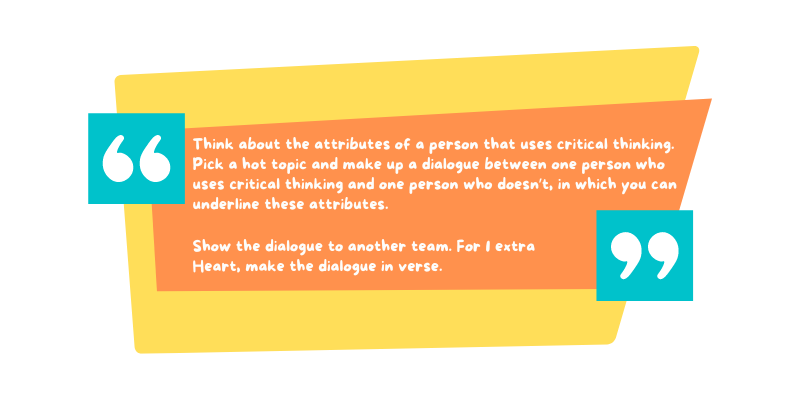
The GAMED project makes available to secondary education 10 topics with gamified proposals at different levels, and a board game. The eleven proposals in total bring together characteristics that, conveniently presented, can be of great use at this educational level. The topics are attractive for boys and girls between 14 and 18 years old: Creativity, critical thinking, diversity, empathy, sustainability, learning, mental health, teamwork, values.
On each of these topics, GAMED proposes two activities for teenagers. They are activities based on cooperation (they are group activities), which put the topics to reflection and debate and which, therefore, allow different levels of depth. Each proposal has recommendations for the people in charge of dynamizing the student groups, at a level of detail that really facilitates the implementation of the game .
Specially can arouse the interest of secondary school students, activities such as:
- Scanning (Teamwork): A self-reflection on own competences to work in teams, analysing the last opportunities you had to do it. Share their own results to the rest of the group.
- Moving to planet Xp7W3k (Values). Roleplay on a fiction. The aim is to select people to be saved travelling to another planet. Discussion on the process and its criteria.
- The commission of migration (Green. Sustainability of the society). Roleplay. A supposed commission of migration must evaluate the capacity of a community to welcome migrants with warranties for both, migrants and autochthones.
- What if it will be… (Empathy). Invitation to participants to experiment and experience specific emotions for a different life perspective, encourage them for a better understanding of the feelings and behaviours of others.
Additionally, it can be a good point to make participants aware about the impact of our messages upon others in different social or communication contexts.
So up to 10 topics with a total of 20 activity proposals. Each teacher can adapt the activities to their own teaching objectives by making the necessary adaptations.


The board game of the GAMED project is a tool aimed at joint reflection on the ten proposed topics, through a strategy game that leads the players through challenges that they must solve in different stations. Each time a challenge is solved you receive points in three different areas depending on the challenge: mental strength, physical ability or emotional strength.
It's a game where every player is a team. Its characteristics make it difficult for a team to win without negotiating with the others.
The reasons appointed, lead us to suggest the suitability of the GAMED activities into Secondary Education, inside or outside the classrooms, but embedded in some way and complementarily in the curriculum.